
IV.B.5 Head: CN IX & CN X Page 1 of 4
Objectives:3.5.1 Identify the foramen through which the glossopharyngeal and vagus nerves exit the cranial cavity and include the components of these cranial nerves. 3.5.2 Describe the origin and path of the glossopharyngeal and vagus nerves. 3.5.3 Predict the functional deficits which would result from damage to the hypoglossal nerve CN IX and the vagus nerve CN X. |
Assigned Readings:Moore's COA: Pages 842-844, 924, 946, 979-980, 1014, 1023, 1028, 1030-1031, 1036-1039, 1043-1045, 1062-1069, 1079-1083. See the blue boxes on pages 1090-1091 for clinical correlations. See the yellow boxes on pages 1081, 1083 for "The Bottom Line." |
| Step 1: Begin with the sagittal brain section. | |
| Step 2: Add the glossopharyngeal nerve CN IX. |
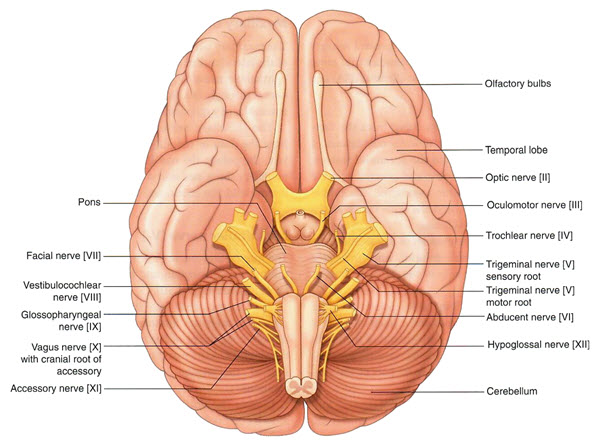
The glossopharyngeal nerve arises as several rootlets from the anteriolateral surface of the medula.
The rootlets cross the posterior fossa and enter the jugular foramen where they merge and exit the foramen as the glossophyngreal nerve.
 |
What other structures exit via the jugular foramen? |
|
Vagus Nerve CN X, Accessory Nerve CN XI, Internal jugular vein. |
|